
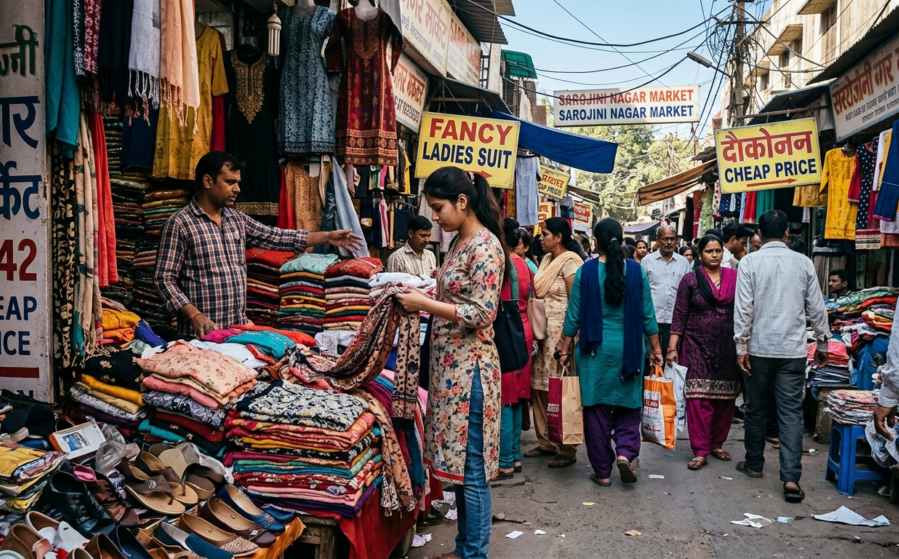
Sarojini Nagar Market, New Delhi :- The Ultimate Capital of Budget Shopping and Trendy Fashion
Situated prominently in South Delhi, Sarojini Nagar Market stands tall not merely as a local bazaar, but as India’s most iconic and celebrated street shopping destination. Universally hailed as a “Shopper’s Paradise,” this bustling commercial ecosystem is where cutting-edge global fashion trends, high-street apparel, and chic lifestyle accessories are retailed at astonishingly low prices. For anyone seeking to completely overhaul their wardrobe with contemporary style without breaking the bank, Sarojini Nagar remains the absolute premier destination in New Delhi.
Detailed History
The operational lineage of Sarojini Nagar Market is deeply intertwined with the urban expansion of New Delhi and the post-partition rehabilitation era.
- Nomenclature and Establishment :– The market was officially named in honor of Sarojini Naidu, the legendary Indian freedom fighter, iconic poet, and the revered “Nightingale of India.” Developed in the early 1950s, the locality was primarily designed as a government residential colony (Government Quarters), with the market initially envisioned to cater to the daily household requirements of the local civil servants.
- The Evolution of its Name :– In its initial years, the locality was designated as ‘Vinay Nagar’ before being renamed to Sarojini Nagar. The commercial expanse naturally segmented over decades into distinct clusters known as Babu Market, the Vegetable Market, and the Central Market, eventually coalescing into a singular, sprawling retail network.
- Metamorphosis into a Street Fashion Mecca :– During the late 1980s and early 1990s, the market underwent a massive economic shift, transitioning from household commodities to surplus export apparel. It became the clearinghouse for excess production lots, canceled international shipments, and garments with microscopic manufacturing variances from top global brands. This unique supply chain turned the market into an immediate magnet for college students and budget-conscious fashion enthusiasts across northern India.
Detailed Architecture
The architectural layout of Sarojini Nagar Market is a classic manifestation of a dense, organic Asian street bazaar, characterized by an intricate and dizzying labyrinth of permanent concrete showrooms and makeshift peripheral stalls.
- Spatial Matrix and Interior Design :– The commercial district is broadly structured around a massive square configuration. While the inner core features brick-and-mortar storefronts, the extended pavements, walkways, and interstitial alleyways are densely lined with semi-permanent kiosks and street vendors. The visual landscape is dominated by vertical columns of hanging apparel, rows of mannequins, and cascading displays of accessories, generating an extraordinarily high visual density.
- Key Commercial Segments :–
- Babu Market :– Located on the north-western fringe of the complex, this structural quadrant is highly specialized in ethnic Indian wear, unstitched dress materials, and traditional footwear.
- The Vegetable Market :– Situated at the southern periphery, this zone maintains the traditional wet-market layout, serving fresh agricultural produce to the local residents.
- Central Market Pavements :– The high-velocity core of the bazaar, where the walkways are completely lined with temporary stalls boasting prominent price tags of ₹50, ₹100, and ₹200.
- Modern Inclusions :– To mitigate the extreme pedestrian and vehicular congestion, a multi-level automated car parking facility has been integrated into the periphery. The internal avenues are strictly pedestrianized, though during peak weekend hours, the foot traffic reaches an extraordinarily high saturation point.
Travel Guide & Routes
To execute a seamless, highly organized, and efficient shopping expedition through Sarojini Nagar Market, refer to this detailed logistical index.
- Market Timings :–
- The retail complex is operational from 10:00 AM to 09:00 PM daily.
- Weekly Holiday :– The market is officially closed on Mondays. While a few scattered street vendors might set up makeshift stalls on pavements on Mondays, all major showrooms and established kiosks remain completely shut.
- Entry Fee :–
- Entry to the entire public commercial district is completely Free of Charge.
- How to Reach :–
- By Metro (The Most Efficient Route) :– The market is directly served by the Sarojini Nagar Metro Station, located on the Pink Line of the Delhi Metro network. Emerging from Exit Gate Number 1 places commuters directly at the immediate boundary of the shopping lanes.
- By Road/Bus :– Nestled in close proximity to the Ring Road and AIIMS, it is highly accessible. Visitors can easily arrive via app-based cabs, auto-rickshaws, or local DTC buses routing through the Sarojini Nagar main bus terminal.
- Photography Spots :–
- The Apparel Canopies :– The towering displays of seasonal merchandise—ranging from vibrant summer dresses to neon winter puffers—offer deep, color-saturated backdrops for street photography.
- The Ethnic Jewelry Tables :– The tightly packed tables of oxidized silver trinkets, bohemian chokers, and metallic earrings provide excellent macro-photography compositions.
- The Human Kinetic Drama :– Capturing the high-energy interactions, expressions of intense bargaining, and moving crowds embodies the raw, authentic spirit of Delhi’s street life.
- Local Flavors (Must-Try Food Joints) :– To replenish your energy during an intense shopping spree, the market offers several legendary street-food outposts:
- Khandani Pakode Wala :– Located near the Ring Road intersection, this multi-generational shop is legendary for serving piping hot, crisp fritters ranging from paneer and onion to stuffed green chilies.
- Kulcha King :– The definitive spot for savoring authentic Amritsari chur-chur kulchas, heavily layered with clarified butter and paired with spicy chickpea curry (chole).
- Sharma Snacks & Local Kiosks :– Universally loved for serving street-style momos, crisp golgappas, and tangy bhalla-papri chaat, washed down with a cold bottle of local Banta (codd-neck bottle lemonade).
- Famous Specialized Items to Buy :–
- Export Surplus Garments :– Factory-surplus items from luxury and high-street global brands like Zara, H&M, ASOS, and Pull&Bear, retailing for a mere fraction of their original cost.
- Contemporary Footwear :– Extensive collections of seasonal boots, sneakers, casual sliders, block heels, and traditional embroidered juttis.
- Curated Accessories :– Modern tote bags, statement sunglasses, utility belts, and a vast ocean of oxidized metallic jewelry.
- Home Utility & Decor :– Artisanal bedspreads, woven cushion covers, ceramic mugs, planters, and quirky kitchenware.
Nearby Attractions
Given its highly central location in South-Central Delhi, a shopping trip here can be effortlessly integrated with visits to these neighboring cultural nodes.
- Delhi Haat, INA :– Situated just one metro station away (approx. 2 km), this open-air government complex acts as a curated repository for authentic multi-state tribal handicrafts and regional cuisines.
- Safdarjung Tomb :– Located 3 kilometers away, this brilliant 18th-century garden tomb represents the architectural twilight of classic Mughal mausoleum design.
- Lodhi Art District :– Roughly 4 kilometers away, this public housing colony has been transformed into India’s first open-air public art gallery, featuring monumental wall murals painted by global street artists.
- Nehru Planetarium & Teen Murti Bhavan :– Located 4.5 kilometers from the market, this historic estate serves as an educational and scientific hub nestled within vast, serene lawns.
Interesting Facts
- The Anatomy of Excess Production :– The garments sold here are primarily overruns from international clothing orders manufactured in India. Brands reject entire lots due to minor errors, such as a microscopic variation in stitch count or an incorrect inner label, allowing these pristine garments to hit the street stalls of Sarojini Nagar.
- The Epicenter of High-Stakes Bargaining :– Sarojini Nagar functions as the ultimate test of a shopper’s negotiating skills. It is an unwritten market norm that the initial price quoted by a street vendor can often be negotiated down by 50% to 70% based entirely on the buyer’s persistence and tact.
- The Cinema and Styling Conduit :– The market serves as a prominent cultural reference point and has been featured in multiple mainstream Bollywood films. Furthermore, professional fashion stylists and costume designers frequently scour these lanes to curate authentic, casual urban wardrobes for film characters.
Important Questions and Answer :-
Question 1:- Is digital UPI payment universally accepted across the street stalls of Sarojini Nagar?
Answer:– While almost all permanent showrooms and mid-sized kiosks seamlessly accept UPI applications (Google Pay, PhonePe, Paytm), very small pavement vendors selling low-value items (like ₹30 rings or ₹50 hair accessories) still strictly demand cash. Additionally, due to the extreme density of the crowd, local cellular networks often get congested, making digital transactions fail. Thus, carrying ample physical cash is highly recommended.
Question 2:- What is the most strategic time and day to schedule a shopping trip here?
Answer:– To avoid the chaotic influx of crowds, the absolute best window is from Tuesday to Friday between 11:00 AM and 02:00 PM. During these early hours, vendors open their fresh daily stock, and you can browse the narrow lanes with minimal friction. Weekends should be avoided unless you are comfortable navigating through extreme foot traffic.
Question 3:- Is there a policy for exchanging or returning garments purchased from street vendors?
Answer:– Pavement vendors and small mobile stalls operate under a strict “no returns, no exchanges” policy. While a few larger permanent shops might allow item exchanges specifically on Tuesday mornings, it requires prior confirmation at the time of purchase. It is vital to meticulously inspect every garment for structural tears, stains, or missing buttons before handing over the money.
Question 4:– Are there dedicated public trial rooms available within the street market area?
Answer:– No, open street stalls do not possess changing or trial rooms. Shoppers must evaluate sizing visually, often by holding the garment up against themselves or measuring it against a piece of clothing they are already wearing. A seasoned insider tip is to carry a compact measuring tape in your bag to verify dimensions on the spot.
Author’s Thoughts
From an analytical viewpoint, Sarojini Nagar Market is far more than a high-density retail hub; it is a fascinating sociological phenomenon that democratizes fashion. It breaks down the elite barriers of luxury global trends, proving that looking highly stylish does not require a massive financial fortune. The true magic of this space lies in its sheer social convergence—it is a place where wealthy fashion influencers, corporate professionals, and strapped college students stand side-by-side on the exact same pavement, collectively engaging in the shared art of negotiation. It forces you to activate your spatial awareness, sharpens your eye for quality, and rewards patience like no modern shopping mall ever can. If you wish to experience the true, unedited, high-octane commercial pulse of Delhi’s youth culture, navigating the vibrant grid of Sarojini Nagar is an absolute necessity.
“A thrilling open-air arena where high fashion meets baseline budgets, and the power of negotiation reigns supreme—that is the unmatched energy of Sarojini Nagar Market.”