
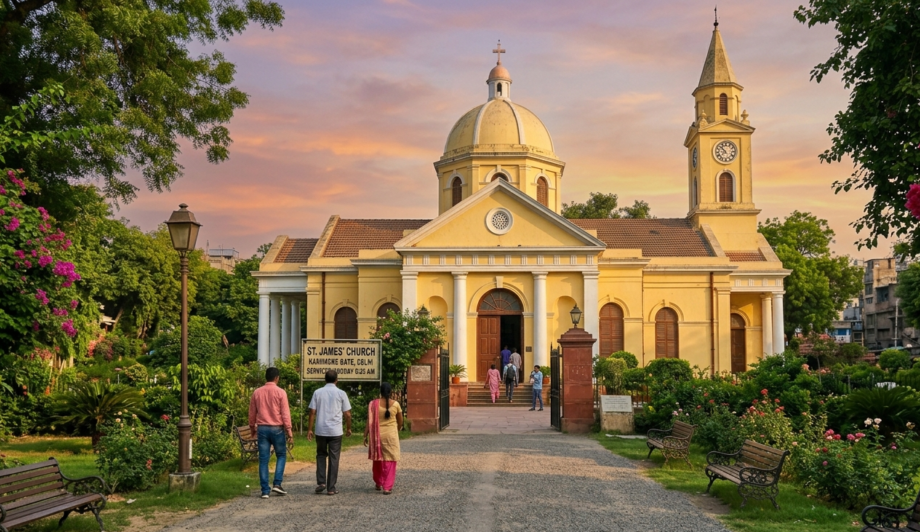
Detailed History
St. James’ Church, also affectionately known as ‘Skinner’s Church‘, is the oldest surviving and functioning church in the capital city of Delhi. It was commissioned by Colonel James Skinner, a legendary and charismatic military officer of the British Indian Army. According to historical accounts, during the early 1800s, James Skinner was lying critically wounded on a battlefield, facing near-certain death. In that desperate moment of survival, he made a solemn vow to God that if his life were spared, he would build a grand church in His honor. True to his word, after recovering, he financed the entire construction of this church from his personal funds at a staggering cost of around 95,000 rupees at the time. The architectural design was prepared by Major Robert Smith. The construction began in the year 1826 and it took a decade of meticulous work to finally complete it in 1836. The church stands as a monumental witness to the early colonial history and architecture of India.
Detailed Architecture
The architecture of St. James’ Church stands in stark, elegant contrast to the Mughal monuments that dominate Old Delhi, beautifully showcasing the European Renaissance revival style.
- Exterior Architecture :– The fundamental layout of the church is built in the shape of a Greek cross (Cruciform plan). The central defining feature of the church is its magnificent octagonal dome, topped with a copper ball and a large cross, which dramatically punctures the skyline of the Kashmere Gate area. The exterior walls are painted in a soothing hue of colonial yellow and white, emphasizing its neoclassical symmetry and simple elegance. The main entrance features majestic, deep porches supported by classical pillars reminiscent of Roman architecture.
- Interior Architecture :– The interior of the church exudes an aura of profound tranquility and old-world charm. Upon entering the main prayer hall, one’s eyes are instantly drawn to the exquisite, antique stained-glass windows above the altar, depicting vivid scenes from the life and crucifixion of Jesus Christ. The church also houses a rare, historic British-era pipe organ. The walls inside are lined with poignant marble plaques and memorials dedicated to British officers and members of the Skinner family. Outside, the serene churchyard contains the historic graves and tombs of Colonel James Skinner, his family members, and several other prominent colonial residents of Delhi.
Travel Guide & Routes
- Ticket and Fees :– Entry to St. James’ Church is absolutely Free for all visitors and tourists. There are no fees collected for entering the premises.
- Visiting Time :– The church is generally open to visitors from 9:00 AM to 5:00 PM on weekdays. On Sundays, the church holds traditional morning services, during which general tourist movement inside the prayer hall may be briefly restricted to maintain sanctity.
- How to Reach :–
- By Metro :– The most effortless way to reach the church is via the Delhi Metro. You can deboard at the ‘Kashmere Gate Metro Station’ (a major interchange station for Red, Yellow, and Violet lines). The church is just a 2-3 minute walk from Gate No. 1 of the station.
- By Road :– The church is located on Lothian Road at Kashmere Gate. You can easily board any public bus heading towards Kashmere Gate ISBT, or hail an auto-rickshaw or app-based cab directly to the church gates.
- Photography Spots :– To maintain the spiritual environment, photography inside the inner prayer hall is strictly prohibited. However, the outside of the colonial-era yellow structure, the majestic central dome, and the surrounding lush, peaceful green gardens provide a visually spectacular backdrop for exterior photography.
- Local Food :– The nearby Kashmere Gate market features old-school eateries serving legendary Delhi street foods like chole bhature, bedmi poori, and kachoris. Moreover, the culinary heaven of Chandni Chowk and its famous ‘Paranthe Wali Gali’ are just one metro station away.
- Famous Markets :– The immediate vicinity includes the bustling Kashmere Gate and Mori Gate automotive markets. A short distance away lies the historic Chandni Chowk bazaar and the famous Chor Bazaar, where shoppers can hunt for vintage goods, electronics, and traditional textiles.
Important Questions and Answer :-
Question 1: Who constructed St. James’ Church and what was the story behind it?
Answer:- It was built by Colonel James Skinner. He commissioned it to fulfill a personal vow he made to God while lying severely wounded and fighting for his life on a battlefield, promising a church if he survived.
Question 2:- What architectural style does St. James’ Church feature and what are its highlights?
Answer:- The church is built in the European Renaissance revival style on a cruciform (Greek cross) layout. Its primary architectural highlights include the grand central octagonal dome and the intricately detailed antique stained-glass windows.
Question 3:- Where is St. James’ Church located in Delhi and what is the easiest way to reach it?
Answer:- The church is located on Lothian Road in the Kashmere Gate area of Old Delhi. The easiest way to reach it is by taking the metro to the Kashmere Gate Metro Station, from where it is within walking distance.
Author’s Thoughts (Personal Perspective) :-
Stepping out of the chaotic, horn-blaring streets of Kashmere Gate into the heavily shaded, quiet compound of St. James’ Church feels like slipping through a portal to another century. To my mind, this structure is far more than just brick and colonial mortar; it is a physical manifestation of a soldier’s unwavering faith and a profound monument of gratitude. While most historical landmarks in Delhi narrate the tales of Mughal emperors and sultans, St. James’ Church offers a rare, intimate look into the very dawn of Delhi’s colonial transition. The soft, colorful light filtering through the stained glass inside, combined with the deep stillness of the graveyard outside, forces one to pause and reflect on the fleeting nature of time. For any history buff or architectural enthusiast, this oldest church in Delhi is an incredibly enriching, unmissable experience.
Interesting Facts
- The church earned the moniker ‘Skinner’s Church‘ because Colonel James Skinner paid for it entirely out of his own pocket. He was the founder of the legendary irregular cavalry regiment known as ‘Skinner’s Horse’.
- During the Uprising of 1857 (Sepoy Mutiny), the church came under heavy fire and sustained significant damage. Bullet marks from that volatile period of history can still be seen on the copper ball atop the central dome.
- Although Colonel James Skinner passed away in Hansi (Haryana) in 1841, his remains were later disinterred and brought to this church to be buried right beneath the main altar, fulfilling his final wish.