
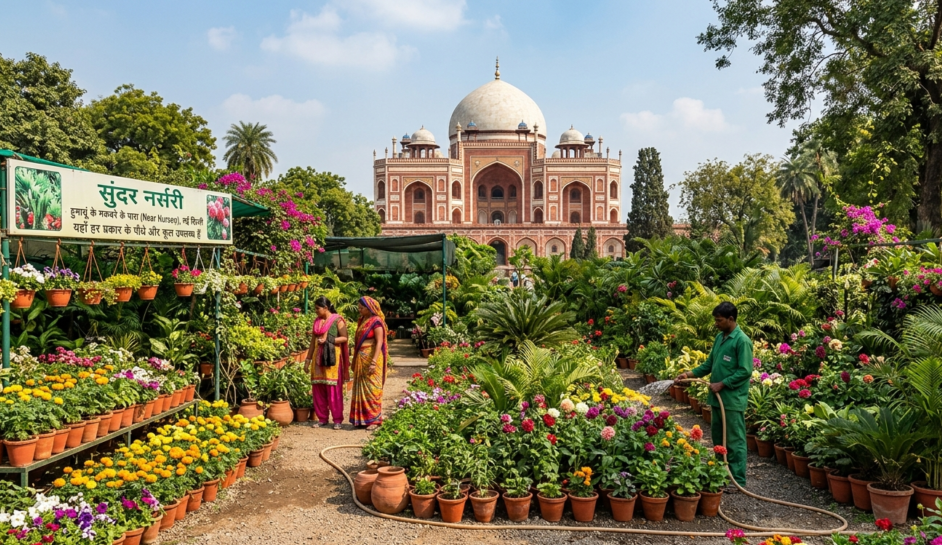
Sundar Nursery, Delhi :- A Sublime Blend of Nature, History, and Tranquility
Amidst the bustling, fast-paced life of Delhi, if you are searching for a serene sanctuary where birds chirp, Mughal-era monuments stand tall, and a lush green canopy blankets the earth, then Sundar Nursery is your ultimate destination. Located right adjacent to Humayun’s Tomb, this UNESCO World Heritage Site is not just a historical garden, but also Delhi’s first-ever ‘Arboretum‘ (a unique botanical collection of trees). Let’s embark on a detailed journey through this beautiful paradise.
Detailed History
The history of Sundar Nursery dates back nearly 400 years, deeply rooted in the Mughal era. In the 16th century, this expansive region was known as ‘Azim Bagh’. It housed numerous Mughal monuments, tombs, and formal gardens that gradually fell into ruin over centuries.
At the dawn of the 20th century, when the British government decided to shift the capital from Calcutta (now Kolkata) to Delhi, millions of plants and trees were required to landscape New Delhi. In 1913, British architect A.D. Musto developed this site into a nursery to propagate saplings for the capital’s grand avenues and experimental flora. It was named Sundar Nursery after the ‘Sundar Buraj’, a breathtaking Mughal monument located within the premises.
After decades of neglect, a massive restoration project was launched in 2007 by the Aga Khan Trust for Culture (AKTC), in collaboration with the Central Public Works Department (CPWD) and the Municipal Corporation of Delhi. Following 10 years of painstaking restoration, it was opened to the public in 2018 as a world-class heritage park. In the same year, ‘Time Magazine‘ featured it in its list of the World’s 100 Greatest Places.
Detailed Architecture
Spanning across a massive 90 acres, the architecture of Sundar Nursery is an immaculate blend of classic Mughal symmetry and contemporary landscaping. The entire park is designed around a central grand axis, reminiscent of the traditional Mughal ‘Charbagh’ layout.
- Historical Monuments :– The complex houses 6 UNESCO World Heritage monuments. Among them, Sundar Buraj and Sundar Wala Mahal are the most prominent. The intricate Arabic calligraphy, detailed stucco plasterwork, and grand domes of these buildings reflect the zenith of Mughal architectural grandeur. Other notable structures include ‘Lakkarwala Buraj’ and the ‘Tomb of Mirza Muzaffar Hussain’.
- Interior Layout :– The inner design features cascading white marble fountains, geometric water channels, and beautifully crafted sandstone benches that offer elegant seating spaces.
- Exterior Layout & Natural Landscape :– A vast, scenic artificial lake serves as the centerpiece of the park’s outer layout, creating a micro-climate that enhances the peaceful ambience. The nursery is home to over 300 rare tree species, 80+ species of birds, and 60+ species of butterflies. It also features a dedicated ‘Bonsai House’ and a sunken amphitheater for cultural gatherings.
Travel Guide & Routes
To make your visit seamless, all essential travel details are curated below in a sequential manner.
- Opening Times :– Open 365 days a year.
- Summers :– 06:00 AM to 09:00 PM (Last entry at 08:30 PM)
- Winters :– 07:00 AM to 10:00 PM (Last entry at 09:30 PM)
- Ticket Prices :–
- Indian Citizens :– ₹50 per person
- Senior Citizens (Above 60 years) :– ₹25 per person
- Children (5 to 12 years) :– ₹25 per person (Free entry for children under 5)
- Foreign Tourists :– ₹200 per person
- How to Reach :–
- By Metro :– The nearest metro station is JLN Stadium on the Violet Line. The nursery is about 1-1.5 km away from here, which can easily be covered via an auto-rickshaw or a brisk walk. Alternatively, Lajpat Nagar or Hazrat Nizamuddin metro stations (Pink Line) can also be used.
- By Road/Bus :– Located on Mathura Road next to Humayun’s Tomb, it is easily accessible via cabs, autos, or DTC buses stopping at the Hazrat Nizamuddin bus stop.
- By Train :– The Hazrat Nizamuddin Railway Station is just 1 km away.
- Photography Spots :–
- In front of Sundar Buraj Fountain :– Perfect for capturing the reflection of the monument in the clear water channels.
- The Central Lake :– Offers stunning views during sunset when the park’s soft lighting reflects off the water.
- Bonsai Garden & Tree Avenue :– Ideal for nature lovers, portraits, and aesthetic video reels.
- Local Flavors :– Inside the nursery sits the highly acclaimed ‘Fabcafe by the Lake’. Here, you can dine right next to the water and relish healthy, delicious Indian cuisine such as Ragi Mutton Cutlets, Water Chestnut Samosas, and hot Masala Chai. Pop-up food stalls are also common during weekends.
- Famous Nearby Markets :– Post your walk, you can explore Bhogal Market, Lajpat Nagar (Central Market), or the upscale Khan Market for exceptional shopping and street food.
Nearby Attractions
You can easily pair your visit to Sundar Nursery with these spectacular nearby landmarks.
- Humayun’s Tomb :– Sharing a boundary wall with the nursery, this grand Mughal monument served as the architectural inspiration for the iconic Taj Mahal.
- Hazrat Nizamuddin Dargah :– Located just 500 meters away, this historic Sufi shrine is globally renowned for its soulful qawwali sessions on Thursday and Friday evenings.
- Waste to Wonder Park :– Located near Sarai Kale Khan, this park features beautiful replicas of the Seven Wonders of the World crafted entirely out of industrial and domestic scrap metal.
- Lodhi Garden :– Situated about 3-4 km away, it is another spectacular historical park housing the tombs of the Sayyid and Lodhi dynasties.
Interesting Facts
- Delhi’s First Arboretum :– Housing over 300 unique species of trees, several of which are the only specimens left in Delhi, it serves as the city’s first officially recognized botanical tree sanctuary.
- A Birdwatcher’s Paradise :– The park attracts over 80 distinct avian species, making it a hidden treasure trove for bird enthusiasts in the heart of the metro city.
- Cultural Hub :– The park hosts the popular ‘Sunday Farmers Market’, celebrating organic produce and artisanal goods. It also frequently serves as a venue for open-air classical music concerts and theater.
- Global Recognition :– In 2020, UNESCO honored Sundar Nursery with the prestigious ‘Award of Excellence’ for its outstanding heritage conservation efforts.
Important Questions and Answer :-
Question 1:– Is outside food allowed inside Sundar Nursery?
Answer:– Yes, Sundar Nursery is one of the few parks in Delhi that welcomes families to bring home-cooked food, picnic baskets, and mats. However, littering and the use of single-use plastics are strictly prohibited.
Question 2:– What is the best time of the year to visit Sundar Nursery?
Answer:– The winter months from October to March offer the most pleasant weather to enjoy the park. Arriving early in the morning or during the late afternoon is ideal to experience the tranquil breeze and soft sunlight.
Question 3:– Is parking space available at the venue?
Answer:– Yes, a spacious paid parking facility managed by the authorities is available right outside the main entrance for both two-wheelers and four-wheelers.
Author’s Thoughts
In my perspective, Sundar Nursery is not merely a park or a botanical garden; it is a living ‘green vault’ that breathes life into the concrete jungle of Delhi. The seamless manner in which ancient history and modern ecological conservation have been woven together is truly commendable. If you desire to escape the relentless noise, traffic, and chaos of Delhi to read a book in peace, paint, or enjoy a wholesome picnic with loved ones, there is no better place. It offers you the profound depth of history alongside the comforting embrace of Mother Nature.
“A gorgeous retreat where history rests under the shade of nature, and Delhi stops to take a peaceful breath—that is Sundar Nursery.”