
The Glorious Story of India’s Independence Day :- Struggle, Sacrifice, and the Grand Celebration of Freedom
Detailed History
August 15 is not merely a calendar date; it is the heartbeat of every Indian. It marks the historic day when India broke free from nearly two centuries of British colonial rule and stepped into a new era of freedom and sovereignty. This journey to independence was not achieved overnight; it was forged through the supreme sacrifices of millions of patriots, unyielding determination, and decades of struggle.
British rule in India gained firm footing after the Battle of Plassey in 1757 as the East India Company gradually expanded its administrative and economic control over the subcontinent. The oppressive policies, severe economic exploitation, and destruction of local industries created widespread discontent among Indians.
The First War of Independence (1857)
The revolt of 1857, initiated by Mangal Pandey, laid the foundation of the freedom movement. Legendary figures like Rani Lakshmibai, Tatya Tope, Kunwar Singh, and Bahadur Shah Zafar rose in rebellion against British tyranny. Although suppressed, it sparked a permanent wave of nationalism across India.
Mass Movements & Revolutionary Struggles
In the 20th century, Mahatma Gandhi transformed the freedom movement into a mass revolution through Non-Violent Civil Disobedience, the Non-Cooperation Movement (1920), the Salt March (1930), and the Quit India Movement (1942).
Concurrently, Netaji Subhash Chandra Bose’s Azad Hind Fauj (INA) and the heroic sacrifices of revolutionaries like Bhagat Singh, Chandrashekhar Azad, Rajguru, Sukhdev, and Ram Prasad Bismil forced the British Empire to realize that their rule was no longer sustainable. On the midnight of August 14-15, 1947, India emerged as an independent nation, celebrated by Jawaharlal Nehru’s iconic address, “Tryst with Destiny”.
Detailed Architecture (Red Fort Venue) :-
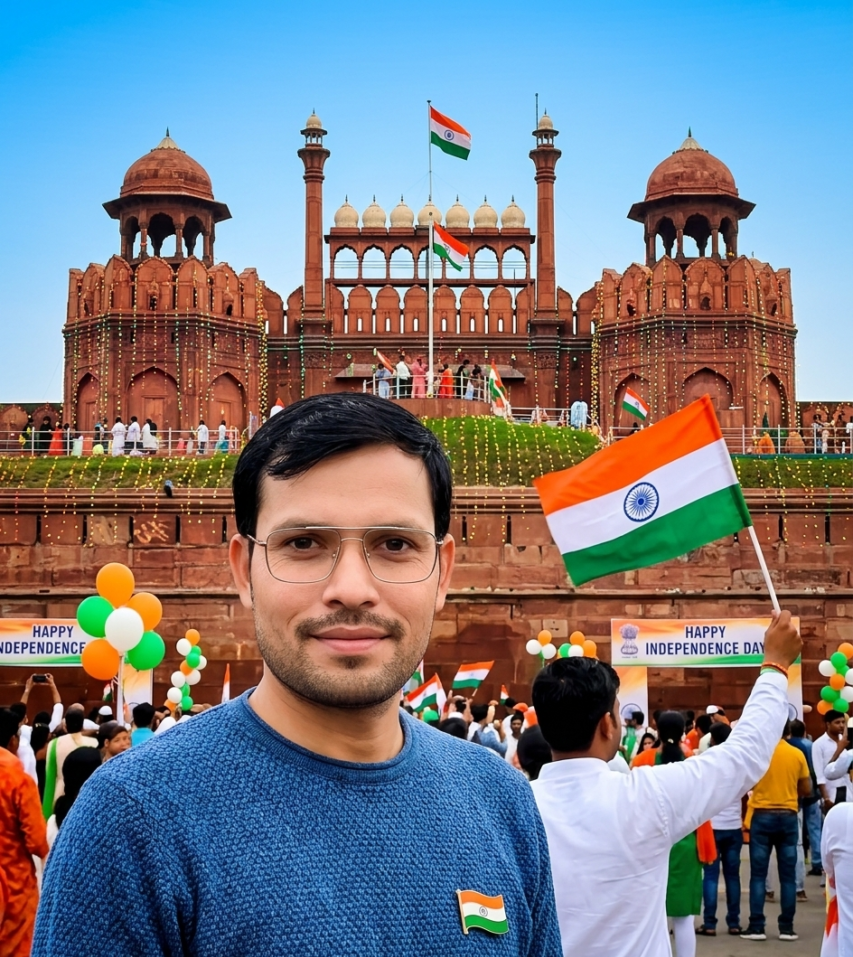
The primary and most grand national celebration takes place at the iconic Red Fort (Lal Qila) in Old Delhi, which stands as the ultimate symbol of Indian sovereignty.
- Lahori Gate :– The main entrance gate of the Red Fort, which serves as the focal point of the Independence Day celebration where the Prime Minister hoists the National Flag.
- Ramparts :– The formidable red sandstone walls and ramparts from where the Prime Minister delivers the annual televised address to the nation.
- Decorations :– The entire complex is illuminated and decorated in vibrant tri-color themes (Saffron, White, and Green) with floral arrangements and flags.
Travel Guide & Routes :-
If you plan to experience or visit Delhi during Independence Day celebrations.
- Ticket & Entry Details :– Entry to the main ceremony at the Red Fort is strictly restricted to official invitation pass holders and verified e-tickets issued by the Ministry of Defence portal. The ceremony begins at 7:00 AM, and security protocols require guests to arrive by 5:30 AM.
- How to Reach :– The nearest metro stations are Red Fort (Violet Line) and Chandni Chowk (Yellow Line). Due to strict security cordons, major roads surrounding the fort are closed to private vehicles; using the Delhi Metro is highly recommended.
- Local Food & Markets :– Following the event, visitors can explore Old Delhi’s culinary landmarks, including the historic Paranthe Wali Gali, Mughlai delights at Karim’s, and traditional sweets. Nearby markets like Meena Bazaar and the Daryaganj Book Market offer vibrant local shopping experiences.
Interesting Facts :-
- Why August 15 Was Chosen :– Lord Mountbatten chose August 15 because it marked the second anniversary of Japan’s surrender to the Allied Forces in World War II in 1945.
- Independence Without a National Anthem :– India did not have an official national anthem on August 15, 1947. Rabindranath Tagore’s ‘Jana Gana Mana’ was officially adopted as the national anthem on January 24, 1950.
- Other Countries Celebrating August 15 :– Five other nations celebrate their independence on August 15—South Korea, North Korea, Bahrain, Republic of the Congo, and Liechtenstein.
- Flag Hoisting vs. Flag Unfurling :– On August 15 (Independence Day), the flag is positioned at the bottom of the pole and pulled upward before being opened (Flag Hoisting). On January 26 (Republic Day), the flag is already tied at the top and simply opened (Flag Unfurling).
Important Questions and Answer :-
Question 1:- Who hoists the National Flag at the Red Fort on August 15?
Answer:– The Prime Minister of India hoists the national flag from the ramparts of the Red Fort on Independence Day.
Question 2:– Where was Mahatma Gandhi on August 15, 1947?
Answer:– Mahatma Gandhi was in Noakhali (now in Bangladesh), fasting and striving to quell communal violence and restore peace.
Question 3:- Who designed the national flag of India?
Answer:– The national flag of India was designed by freedom fighter Pingali Venkayya.
Author’s Thoughts
”Independence Day is not just a commemoration of past glory, but a reminder that the freedom we enjoy today was bought with the blood and supreme sacrifice of martyrs. Preserving this liberty and steering the country toward progress is the solemn duty of every citizen. Until we fulfill our civic duties with integrity, the India of our martyrs’ dreams remains incomplete.”
“August 15 is not just a day to honor the sacrifices of our past, but an unbreakable resolve to build a bright, strong, and self-reliant future for India.”