
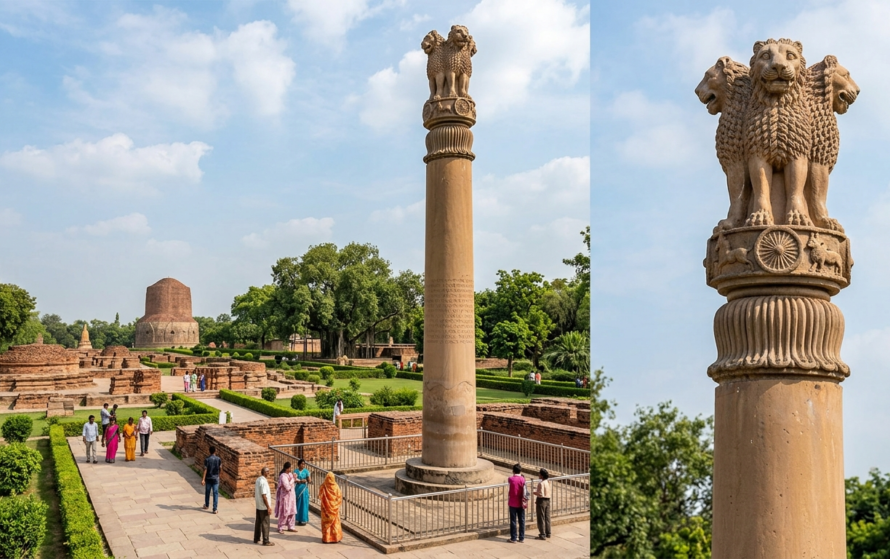
The Ancient Guardians of Delhi :- The Historic Ashoka Pillars
When we discuss the multi-layered history of Delhi, our focus naturally drifts toward the grand Mughal mausoleums or the rugged forts of the Delhi Sultanate. However, very few realize that etched upon the soil of Delhi is a history dating back to the 3rd century BCE, belonging to one of India’s greatest emperors—Ashoka the Great. Delhi houses not just one, but two historic Ashoka Pillars. Interestingly, these pillars were not native to Delhi; they were transported here from hundreds of miles away. In this detailed blog, let us discover the history, monolithic architecture, and travel guide of these ancient, gleaming sentinels.
Detailed History
The journey of these two pillars to Delhi is an extraordinary saga connecting the ancient Mauryan Empire’s grandeur with the medieval Tughlaq Dynasty’s curiosity and engineering skills.
- Original Construction :– The pillars were commissioned in the 3rd century BCE (around 250 BCE) by Emperor Ashoka of the Maurya Dynasty. He erected them to propagate Buddhism and etch his codes of conduct, peace, and administrative righteousness (Dhamma edicts) for the masses.
- The Migration to Delhi :– These pillars were brought to Delhi in the 14th century (around 1356 CE) by Sultan Feroz Shah Tughlaq of the Tughlaq Dynasty. Feroz Shah had a profound fascination for ancient antiquities and architectural wonders.
- Original Locations of the Pillars :–
- The Feroz Shah Kotla Pillar :– This pillar originally stood in Topra (Ambala, Haryana). To bring it to Delhi, it was carefully wrapped in silks and reeds, lowered onto a massive 42-wheeled carriage pulled by thousands of men, and rafted down the Yamuna River on large boats.
- The Delhi Ridge Pillar :– This pillar originally stood in Meerut (Uttar Pradesh). Feroz Shah Tughlaq transported this as well, installing it near his royal hunting lodge (Kushk-e-Shikar) on the ridge.
Detailed Architecture
The hallmark of Mauryan craftsmanship lies in its unparalleled masonry and mirror-like stone polishing, both of which shine brilliantly through these pillars.
- Monolithic Structures :– Both pillars are entirely monolithic, meaning each was chiseled out of a single, colossal block of Chunar sandstone, rather than joined with bricks or mortar. The Topra pillar stands over 13 meters tall.
- The Mirror-Like Metallic Polish :– The pillars feature a secret Mauryan silk-smooth polishing technique. Despite enduring over two millennia of open skies, scorching sun, and monsoons, they retain a sheen that often tricks observers into thinking they are cast from metal or iron. Feroz Shah Tughlaq himself was captivated by this and dubbed it the ‘Golden Minaret’ (Minar-e-Zarin).
- Ancient Inscriptions :– The pillars bear the seven principal edicts of Emperor Ashoka written in the Brahmi script and Prakrit language. The Topra-Delhi pillar is especially vital because it also features three later inscriptions by the 12th-century Chauhan king, Vigraharaja IV.
Travel Guide & Routes
Since these pillars are located at two entirely different locations in Delhi, here are the travel logistics for both.
1. Feroz Shah Kotla Pillar (Vikramjeet Singh Sanatan Dharma Marg, New Delhi)
- Tickets :– The entry ticket to the Feroz Shah Kotla Fort costs around ₹20 to ₹25 for Indian citizens (discounts apply for online bookings).
- Timings :– Open from 10:00 AM to 6:00 PM (Usually closed on Mondays, verify locally before visiting).
- How to Reach :– The nearest metro station is ‘Delhi Gate’ (Violet Line). The fort complex is located within a short walking distance from the station.
2. Delhi Ridge Pillar (Near Bara Hindu Rao Hospital, Northern Ridge)
- Tickets :– Located in an open, public ridge reserve, access to this pillar is completely Free.
- Timings :– Open 24 hours, but for safety and optimal lighting, visiting between 7:00 AM and 6:00 PM is highly recommended.
- How to Reach :– The closest metro stations are ‘Pul Bangash’ (Red Line) or ‘Civil Lines’ (Yellow Line). From there, you can hire an auto-rickshaw to take you up to the pillar near Hindu Rao Hospital.
Photography Spots
For history buffs and framing enthusiasts, these ancient obelisks present dramatic visual narratives.
- The Pyramidal Superstructure at Kotla :– At Feroz Shah Kotla, the pillar is mounted atop a unique, three-storied pyramidal stone pavilion. Capturing the entire tiered structure rising against the sky from the low-angle lawns creates a monumental frame.
- The Brahmi Script Macro Shots :– Getting a close-up of the ancient Brahmi characters etched perfectly into the polished sandstone surface offers incredible texture for historical photography.
- The Ridge Canopy :– The Meerut pillar on the Northern Ridge is surrounded by dense forest canopies. Early mornings offer soft, filtered sunlight cutting through the trees onto the vintage stone pillar.
Local Food & Famous Markets
Both monuments sit adjacent to premium Old Delhi culinary zones and vibrant street markets.
- Local Food :–
- Near Feroz Shah Kotla :– The surrounding Daryaganj area is famous for its rich Mughlai Kebabs, legendary Butter Chicken, and proximity to the street food of Old Delhi.
- Near Delhi Ridge :– The adjoining Kamla Nagar area is a student paradise, famous for its steaming Chole Bhature, crispy Kachoris, and localized street chaat.
- Famous Markets :–
- Daryaganj Book Market :– If visiting on a Sunday, you can browse through the famous sprawling street book market nearby.
- Kamla Nagar Market :– A bustling shopping district famous for trendy apparel, footwear, and accessories near the University enclave.
Nearby Attractions
- Near Feroz Shah Kotla :– You can easily add the Shankar’s International Dolls Museum, National Bal Bhavan, and Raj Ghat (Mahatma Gandhi’s Memorial) to your itinerary.
- Near Delhi Ridge :– Explore the historic ‘Flagstaff Tower’ (a crucial site during the Revolt of 1857) and the beautiful, colonial-era campus of Delhi University’s North Campus.
Interesting Facts
- The Illusion of Gold :– When Sultan Feroz Shah first spotted the Topra pillar, its brilliant Mauryan glaze led him to believe it was fashioned from solid gold. Hence, contemporary chroniclers labeled it Minar-e-Zarin.
- Shattered by an Explosion :– In the 18th century, a gunpowder magazine explosion on the ridge shattered the Meerut-Delhi pillar into five distinct fragments. The pieces were carefully reassembled and re-erected much later in 1867 during British rule.
- Akbar’s Curiosity :– The Mughal Emperor Akbar was deeply intrigued by the text carved on these pillars and summoned multiple scholars to decipher it; however, no one at the time could read the ancient Brahmi script. It was finally decoded in 1837 by British antiquarian James Prinsep.
Important Questions and Answer :-
Question 1:– How many Ashoka Pillars are there in Delhi and where are they located?
Answer:– There are two Ashoka Pillars in Delhi. One is located inside the Feroz Shah Kotla Fort complex on Bahadur Shah Zafar Marg, and the second is positioned in the Northern Ridge area near Hindu Rao Hospital.
Question 2:– Who brought these ancient pillars to Delhi?
Answer:– Both pillars were brought to Delhi in 14th century (1356 CE) by Sultan Feroz Shah Tughlaq, who had them transported from Topra (Haryana) and Meerut (Uttar Pradesh).
Question 3:– What material are the Ashoka Pillars made of?
Answer:– The pillars are monolithic structures sculpted out of a single block of premium Chunar Sandstone, famous for its enduring, mirror-like Mauryan glaze.
Question 4:- Which is the closest metro station to the Feroz Shah Kotla Ashoka Pillar?
Answer:– The nearest metro station is ‘Delhi Gate’ on the Violet Line.
Author’s Thoughts :-
Gazing up at the Ashoka Pillar mounted gracefully atop the three-tiered ruins of Feroz Shah Kotla, one feels time folding back on itself. This pillar is not merely an architectural relic; it represents the convergence of two entirely different eras—the profound spiritual pacifism of Emperor Ashoka from antiquity and the intellectual curiosity of Feroz Shah Tughlaq from the medieval ages. It is mind-boggling to conceive how, without modern heavy cranes, this immense 2,300-year-old stone obelisk was safely brought down the river. Standing silent amidst the concrete rush of modern Delhi, these pillars serve as a quiet reminder of how deep, tolerant, and glorious the roots of Indian civilization truly are. The timeless gleam of its stones urges us to look within and polish our own values.
“Having traveled hundreds of miles to brush against the sky of Delhi, Emperor Ashoka’s monolithic pillars stand as timeless sentinels, reflecting the glorious light of ancient Indian wisdom onto the modern world.”