
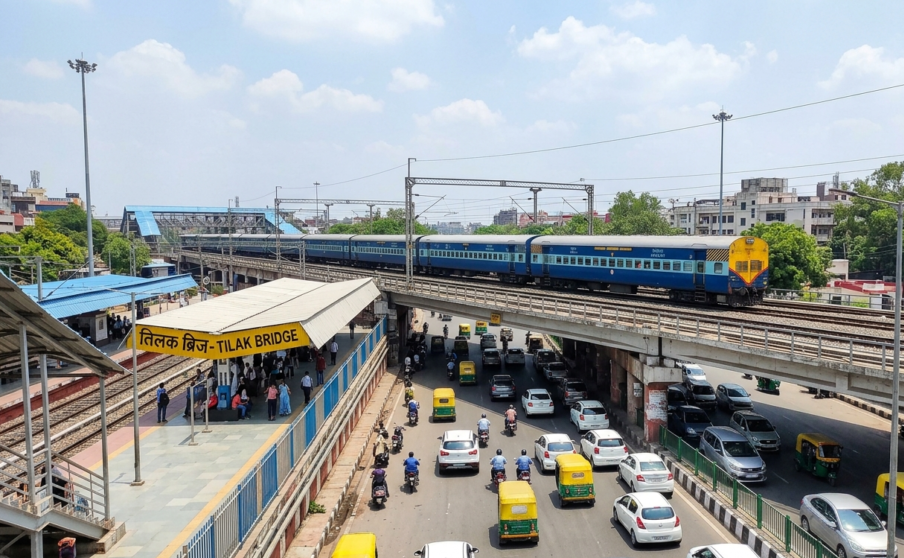
Tilak Bridge Delhi :- History, Architecture, and Complete Travel Guide
Detailed History
Tilak Bridge in Delhi is not just a railway bridge but a historical link connecting Lutyens’ Delhi with Central Delhi. Designed during the British era during the construction of New Delhi, this railway line and bridge were planned to connect Connaught Place with key administrative zones. Post-independence, the entire area and the bridge were renamed ‘Tilak Bridge‘ to honor the great freedom fighter Lokmanya Bal Gangadhar Tilak. Falling under the Northern Railway Division of Indian Railways, this location serves as the pulse of Delhi for thousands of daily commuters and office goers.
Detailed Architecture :-
- Exterior Architecture :– The exterior structure of Tilak Bridge relies on robust steel girders and heavy concrete pillars, spanning across the busy ITO roadway below.
- Interior Details :– The interior of Tilak Bridge railway station features two main platforms connected by a traditional Foot Over Bridge, equipped with concrete seating and basic passenger shelters.
Interesting Facts :-
- Tilak Bridge is one of the busiest railway links for local commuter trains (EMU) connecting Delhi to Ghaziabad and Faridabad routes.
- The ITO intersection situated directly underneath this bridge is considered the administrative lifeline of Delhi.
- During British rule, this specific track route was primarily utilized for the secured transit of royal and administrative officials.
Nearby Attractions :-
- Supreme Court of India :– This is the highest constitutional court of India, famous for its majestic architecture and legal heritage.
- Pragati Maidan (Bharat Mandapam) :– This is a vast and modern complex that hosts premier global trade fairs and exhibitions throughout the year.
- Mandi House :– This is a famous cultural hub in Delhi, housing several prominent performing arts theatres and art galleries.
- Purana Qila (Old Fort) :– This is an ancient fortress built by Sher Shah Suri, renowned for its massive ramparts and beautiful boating lake.
Travel Guide & Routes :-
- Tickets and Entry :– Local train tickets range from ₹10 to ₹30, and the platform ticket is ₹10; there is no fee to use the bridge’s roadways.
- Visiting Time :– The route is operational 24/7, with peak train frequencies running between 04:00 AM and 11:00 PM.
- Opening and Closing Time :– The railway station premises remain open to passengers 24 hours a day.
- How to Reach :– The nearest metro stations are Supreme Court and Mandi House (Blue and Violet Lines), from where you can easily walk or take an auto.
- Photography Spots :– Capturing a passing train from beneath the bridge or photographing the illuminated Supreme Court and Mandi House roundabout at evening offers great frames.
- Local Food :– Nearby Bengali Market is famous for Chole-Bhature at Nathu’s Sweets and street-style chaat at Bengali Pastry Shop.
- Famous Markets :– Connaught Place (CP) and Janpath Market are closest, globally renowned for pocket-friendly clothing and authentic handicrafts.
Important Questions and Answer :-
Question 1:- Which is the nearest metro station to Tilak Bridge?
Answer:- The nearest metro stations are Supreme Court and Mandi House.
Question 2:- Do all express trains stop at Tilak Bridge?
Answer:- No, only local (EMU) and select passenger trains stop here; express trains pass through without halting.
Question 3:– Are there hotels available for stay near Tilak Bridge?
Answer:- Yes, the adjacent Connaught Place and New Delhi areas offer a wide range of hotels across all budgets.
Author’s Thoughts :-
Observing Tilak Bridge up close provides a unique glimpse into the everyday rush of Delhi’s administrative life seamlessly blending with its massive railway network.
“A beautiful blend of Delhi’s pace and historical space, connecting every commuter to the heart of the capital – that is Tilak Bridge.”