
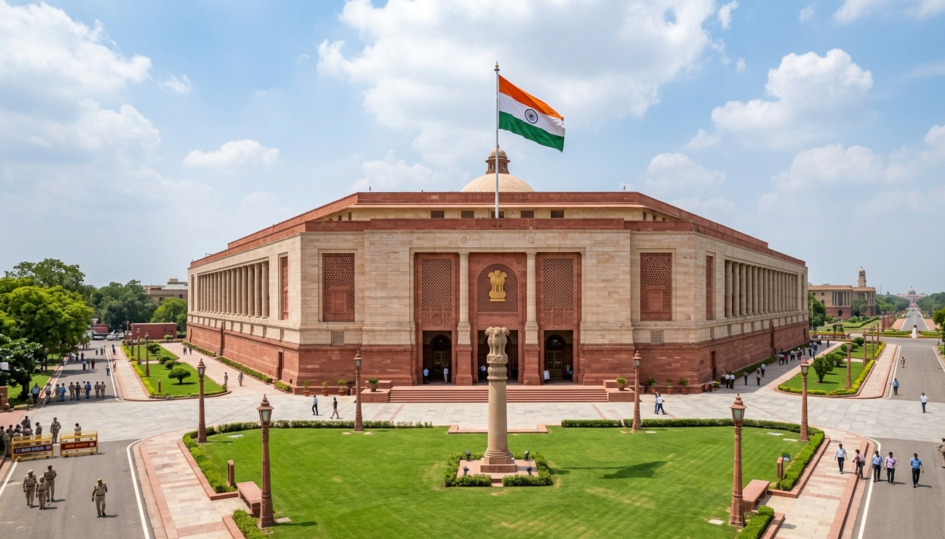
New Parliament House, Delhi :- The Architectural Marvel of Self-Reliant India and Modern Democracy
Detailed History :-
Situated at the ultra-modern heart of New Delhi’s historic Central Vista enclave, the ‘New Parliament House’ stands as the most powerful architectural expression of a rising, self-reliant, and 21st-century India. This monumental structure is far more than the new legislative nerve center of the country; it represents a magnificent fusion of India’s ancient cultural heritage with its future-ready technological aspirations. As the historic Old Parliament House (now designated as Samvidhan Sadan) faced structural fatigue, severe space constraints, and a critical lack of modern communication infrastructure, the crucial need for a state-of-the-art administrative fortress became absolute. Recognizing this, the foundation stone of this iconic monument was laid on December 10, 2020, by Prime Minister Narendra Modi.
Constructed in record time with unyielding engineering precision, the monumental edifice was formally dedicated to the nation on May 28, 2023. The New Parliament House serves as the crown jewel of the Government of India’s expansive ‘Central Vista Redevelopment Project‘. The structural blueprints and master design were envisioned by India’s celebrated master architect, Dr. Bimal Patel, and his acclaimed firm ‘HCP Design‘, while the complex engineering execution was managed by Tata Projects Limited. A historic and highly spiritual centerpiece of this new building is the sacred ‘Sengol’, a historic golden sceptre traced back to the Chool Empire, representing the timeless Indian ideals of righteous governance, truth, and cosmic order, which is honorably placed adjacent to the Lok Sabha Speaker’s chair.
Detailed Architecture :-
The New Parliament House is a masterclass in brutalist structural stability blended with exquisite indigenous fine-art motifs. It balances extreme sustainable engineering with artistic elements sourced from every remote corner of the subcontinent.
- Exterior Architecture :– Breaking away from the circular template of its predecessor, the New Parliament House is sculpted into a highly optimized triangular configuration. This triangular form factor ensures maximum space utilization of the land plot while aligning with the symbolic principles of ‘Sacred Geometry’ (Trishul or Trikona) found in ancient Indian texts. The four-story structure spreads across a massive 64,500 square meters. Its exterior walls are adorned with beautifully carved stone lattices (Jali work) cut from premium red and yellow Dhaulpur sandstone, seamlessly matching the historic Lutyens’ landscape. Crowning the triangular rooftop is the colossal National Emblem of India—a massive bronze sculpture of the Ashoka Lions that announces national sovereignty to the world.
- Interior Architecture :– The indoor configuration presents a breathtaking homage to India’s national symbols across three primary legislative chambers.
- Lok Sabha Chamber :– This grand hall is deeply inspired by India’s national bird, the ‘Peacock’. The ceilings, walls, and luxury carpets feature spectacular green hues, feather patterns, and intricate acoustic panels. It provides an expansive seating layout for 888 members.
- Rajya Sabha Chamber :– The upper house is themed entirely around India’s national flower, the ‘Lotus’. It features a regal crimson-red color scheme, detailed lotus motifs carved into the woodworks, and high-end modern electronic voting docks, seating 384 members comfortably.
- The Constitution Hall :- Positioned centrally within the triangular core, this high-ceilinged hall serves as a digital and artistic gallery showcasing the evolutionary path of Indian democracy and the historical formulation of the Constitution of India. The building’s interior showcases a mosaic of national craftsmanship, utilizing teak wood from Madhya Pradesh, premium carpets from Mirzapur, and structural bamboo panels from Tripura.
Travel Guide & Routes :-
The New Parliament House is located along the highly guarded, high-security institutional stretch of Parliament Street in Central Delhi, positioned directly adjacent to the historic old complex. Here is your essential transit and entry layout.
- Entry Ticket & Admission :– Being the supreme legislative headquarters of India, direct walk-in tourist entry inside the active assembly halls of the New Parliament House is strictly restricted due to national security. However, travelers can appreciate its brilliant triangular facade and grand perimeter gates from the adjoined public walkways. Citizens who wish to witness live active legislative debates during parliamentary sessions must apply for an Official Visitor Pass through the reference or sponsorship of an active Member of Parliament (MP) or via official parliamentary administrative channels.
- Visiting Timings :– Admiring the magnificent exterior masonry and exploring the historic surroundings of Vijay Chowk is best done between 09:00 AM and 05:00 PM daily. Security remains active and hyper-vigilant 24/7.
- How to Reach :–
- By Metro :– The absolute closest and most practical metro transit terminal is the ‘Central Secretariat’ Metro Station, which serves as a major multi-line interchange hub for the Yellow and Violet Lines. The station exits lead directly toward Rajpath and the Parliament complex within a brief 5-minute walk.
- By Bus :– Central Delhi routes navigating toward Krishi Bhawan or India Gate stop at the designated ‘Parliament House’ or ‘Central Secretariat’ bus stops.
- By Auto/Cab :– Given its central position, app-based cabs and local auto-rickshaws offer swift, seamless connectivity to the outer perimeters from Connaught Place or the New Delhi Railway Station (NDLS) within 5 to 10 minutes.
Nearby Attractions :-
- Old Parliament House (Samvidhan Sadan) :– Standing directly opposite, this iconic circular heritage building serves as the parent monument where India’s constitution was drafted and signed.
- Rashtrapati Bhavan :– The spectacular palatial residence of the President of India, boasting unmatched neo-classical architecture, located just a short distance away on Raisina Hill.
- Kartavya Path & India Gate :– The newly transformed, wide ceremonial national avenue and war memorial arch, highly popular for evening walks and landscape photography.
- National Museum :– India’s premier archival repository hosting ancient treasures, Harappan artifacts, and regal art pieces, located nearby on Janpath Road.
- Jantar Mantar :– The fascinating heritage open-air astronomical observatory site built by Maharaja Jai Singh II, further down Parliament Street.
Photography Spots, Local Taste, and Famous Markets :-
- Photography Spots :– Capturing the sharp, modern geometric angles of the triangular structure with the giant bronze Ashoka Crest from the expanses of Vijay Chowk or the adjoined Central Vista lawns offers an awe-inspiring, patriotic frame. (Note :- This is an elite security zone; obey all military and police guidelines. Photography directly at the fortification gates or of security checkpoints is strictly illegal).
- Local Taste :– The tree-lined avenues of Central Delhi are famous for small roadside stalls serving hot milk tea, samosas, and packed snacks for office workers. For premium dining, tourists head to the close-by state bhavan canteens (like Andhra Bhavan or Maharashtra Sadan) for authentic regional thalis, or explore Connaught Place.
- Famous Markets :– The elite circular avenues of Connaught Place, the heritage stalls of Janpath Market, and the handicraft boutiques of State Emporiums on Baba Kharak Singh Marg are located within a 5-minute drive, offering world-class handlooms, souvenirs, and art books.
Interesting Facts :-
- The triangular shape was meticulously chosen because the triangle represents absolute structural stability in modern engineering and holds profound significance as a symbol of cosmic balance and progress across ancient global civilizations.
- The entire project serves as a physical map of India’s geological wealth—the hand-woven carpets were knotted by over 900 artisans in Uttar Pradesh, the royal sandstone came from Rajasthan, and the brass works were forged in Gujarat, making it a true physical manifestation of ‘Make in India’.
- To accommodate future expansions, the New Lok Sabha chamber is uniquely engineered to expand its seating capacity to over 1,272 members during joint sessions, eliminating space issues for centuries to come.
- The building has achieved a platinum-tier ‘Green Building’ certification due to its cutting-edge solar power integration, ultra-efficient water recycling grids, and eco-friendly construction materials. Additionally, it is fortified with Zone-5 earthquake-resistant structural engineering.
Important Questions and Answer :-
Question 1:- When was the New Parliament House officially inaugurated and by whom?
Answer:- The New Parliament House was grandly inaugurated on May 28, 2023, by the Prime Minister of India, Narendra Modi.
Question 2:- What is the architectural concept behind the shape of the new building and who designed it?
Answer:- The building features a highly modern triangular design optimized for space and structural resilience. The master architect behind this landmark project is Dr. Bimal Patel.
Question 3:- What is the significance of the ‘Sengol’ placed inside the new Lok Sabha?
Answer:- The ‘Sengol’ is a sacred historical golden sceptre that symbolizes the transition of power, truth, and ethical governance. It is modeled on the traditions of the ancient Chola Empire of South India and is placed next to the Speaker’s dais.
Author’s Thoughts :-
Standing before the soaring modern lines of the New Parliament House feels like witnessing a new era of national self-respect unfold. While our old circular parliament house was a beautiful witness to our colonial transition and early democratic struggles, this new triangular marvel is a testament to India’s independent capabilities, built entirely by Indian hands, Indian intellect, and Indian wealth. The vibrant peacock theme of the lower house and the serene lotus grace of the upper house show that even as India accelerates into a high-tech future, its heart remains anchored in its cultural roots. This landmark is not just a palace of governance; it is the grand new temple of words where the golden future of the world’s largest democracy will be written for centuries to come.
“The New Parliament House stands as the proud architectural testament of a self-reliant India, carving its monumental destiny into the stone and steel of the 21st century.”