
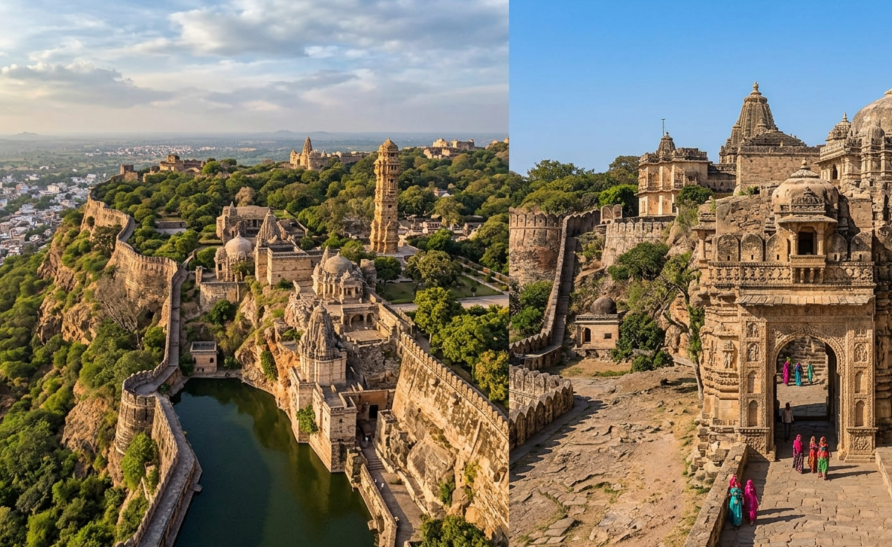
Chittorgarh Fort, Chittorgarh
Following the sky-piercing towers of Kumbhalgarh and the sheer awe of its 36-kilometer continuous defensive wall, let us now direct our steps toward the sacred epicentre of Rajput valor, profound sacrifices, unyielding devotion, and tragic Jauhars – the citadel universally hailed as “The Pride of Rajasthan” and “The Sovereign among All Forts”. Situated in the Chittorgarh district of Rajasthan, Chittorgarh Fort stands as the largest fort complex in India and the entire Asian subcontinent. Anchored majestically atop a high rocky plateau carved by the Gambhiri and Berach rivers, this fortress is not merely a composition of historical stone blocks; it is a living shrine echoing the crackle of queenly fires, the ultimate blood sacrifices of historical titans, and the timeless essence of saintly devotion. In 2013, UNESCO inscribed this monumental landscape as a World Heritage Site.
Detailed History :-
The historical origins of Chittorgarh Fort are so deep-seated that its mythological roots stretch right back to the epoch of the Mahabharata. Local legend maintains that the mighty Pandava brother Bhima engineered the foundations of the citadel, carving out a deep reservoir using a single blow of his massive mace, known today as the ‘Bhimlat Tank‘. Epigraphical records state that the historical baseline fort was commissioned during the 7th century AD by King Chitrangada Mori of the Maurya Dynasty, who named the secure hilltop ‘Chitrakoot‘, which systematically evolved over centuries into ‘Chittorgarh’. In 734 AD, the legendary founder of the Guhil (Gahlot) clan, Bappa Rawal, defeated the Mori rulers, capturing the strategic plateau and declaring it the premier imperial capital of the Mewar Kingdom.
The structural lifespan of Chittorgarh remains the most intensely contested and blood-soaked narrative in medieval Indian history. The fortress bore witness to three cataclysmic sieges that culminated in monumental acts of ‘Saka’ (fighting to the death) and ‘Jauhar’ (collective self-immolation):
- The First Jauhar (1303 AD) :– Orchestrated when Sultan Alauddin Khilji of Delhi launched a massive siege to possess the legendary Queen Padmini (Padmavati). King Ratansen and his legendary generals, Gora and Badal, embraced death on the battlefield, while Queen Padmini led over 16,000 Rajput women into the roaring flames of a massive pyre.
- The Second Jauhar (1535 AD) :– Enacted when Sultan Bahadur Shah of Gujarat breached the outer walls. Queen Karnavati directed the tragic collective immolation of thousands of women, ensuring the infant Prince Udai Singh was smuggled out safely through the ultimate fidelity of the nursemaid ‘Panna Dhai’.
- The Third Jauhar (1567-68 AD) :– Triggered when Mughal Emperor Akbar laid a relentless siege with heavy artillery. The young commanders Jaimal and Patta displayed unimaginable heroism before falling in combat, and Patta’s wife, Queen Phool Kanwar, led the final tragic Jauhar. Following this fall, Maharana Udai Singh retreated to the hills to establish Udaipur, shifting the capital permanently.
Detailed Architecture :-
Spanning an extraordinary 700 acres of flat tabletop land, the fort sits proudly on an isolated rocky ridge rising 180 meters above the valley plains. When viewed from an aerial perspective, the geographical silhouette of the hill closely resembles a giant whale. Its architecture is an absolute masterclass in military defense and structural stonework.
- The Seven Defending Gateways :– Navigating up the steep access road requires passing through a sequence of seven heavily reinforced, staggered gates designed to break the momentum of hostile charges. These are Padan Pol, Bhairon Pol, Hanuman Pol, Ganesh Pol, Jodla Pol, Laxman Pol, and Ram Pol. Elegant stone chhatris (cenotaphs) honoring the martyrs Jaimal and Patta stand near the lower gates.
- Vijay Stambha (The Tower of Victory) :– This is the undisputed architectural crown of the fort grounds. Commissioned by Maharana Kumbha in 1448 to immortalize his decisive victory over the joint armies of Malwa and Gujarat, this 9-story, 37.19-meter-tall sandstone tower is covered in carvings of Hindu deities. Historians frequently describe it as the ‘Encyclopedia of Indian Iconography’.
- Kirti Stambha (The Tower of Fame) :– A magnificent 22-meter-tall, 7-story pillar built during the 12th century by a wealthy Jain merchant named Jijaji Kathar. Dedicated to Lord Adinath, the first Jain Tirthankara, its exterior is intricately sculpted in the traditional Digambara architectural style.
- Rana Kumbha Palace & Padmini Palace :– Rana Kumbha Palace stands as the oldest surviving residential structure within the fort; it was the historic residence of saint-poetess Mirabai and features the dark underground vaults where the historic first Jauhar transpired. Conversely, Padmini Palace is a refined lakeside pavilion whose central water-facing architecture is bound to the legendary reflection narratives of the Khilji chronicle.
- Meera Temple & Kumbha Shyam Shrine :– Built in the ornate Indo-Aryan style, the Meera Temple is dedicated to Lord Krishna and remains a highly spiritual site, preserving the memory of Mirabai’s absolute, unwavering mystical devotion.
- The Sacred Hydraulic Reservoirs :– The absolute marvel of Chittorgarh lies in its brilliant water harvesting layouts. Historically, the fort housed 84 active reservoirs, stepped stepwells, and natural dynamic tanks. The most iconic is the ‘Gaumukh Kund’ (Cow’s Mouth Reservoir), where a natural spring continually gushes out of a rock shaped like a cow’s mouth into a deep green pool.
Travel Guide & Routes :-
Tickets & Entry :–
- For Indian Citizens :– ₹40 per individual (Cash) or ₹35 (via convenient online/digital barcode booking).
- For Foreign Nationals :– ₹600 per individual.
- Camera/Photography Fee :– Capturing pictures using standard personal smartphones or digital cameras is completely free of charge.
- Sound and Light Show :– Viewing the dramatic evening show at the Kumbha Palace ruins costs a separate regulatory ticketing fee of ₹100 per individual.
Timings :–
- Visiting Hours :– Open daily from 09:00 AM to 06:00 PM.
- Operational Days :– The world heritage site is fully accessible to global tourists 365 days a year. Arriving in the early morning hours is highly recommended to beat the mid-day sun.
How to Reach :–
- By Railway :– Chittorgarh Junction is a major broad-gauge railway intersection smoothly linked to prime hubs like Delhi, Jaipur, Kota, Udaipur, and Mumbai. The base of the fort is situated just 5 kilometers from the platform gates.
- By Road/E-rikshaw :– The city is centrally located on National Highway 79 (NH-79) along the Golden Quadrilateral network, offering immaculate road transit options. It is located just 115 kilometers away from Udaipur. Local auto-rickshaws and eco-friendly e-rickshaws are readily available at the bus depots and train stations to cruise up the fort loops. Hiring an auto-rickshaw for a dedicated full-day circuit is the most practical choice.
- By Air :– The nearest airport is Udaipur’s Maharana Pratap Airport (Dabok), positioned roughly 90 kilometers away, which operates daily direct taxi lines up to Chittorgarh.
Photography Spots :–
- The Complete Alignment of Vijay Stambha :– Framing the massive tower from the low-angle lawns right in front of it captures its absolute symmetric majesty beautifully.
- The Stepped Geometry of Gaumukh Kund :– Where the ancient stone temple spires and defensive rock walls cast a sharp, deep reflection upon the clear green water surface.
- Padmini Palace (The Water Pavilion) :– The floating architectural silhouette of the summer palace shimmering on the calm water canvas provides a truly cinematic landscape shot.
Local Food & Shopping :–
- Local Cuisines :– While exploring the historical tracks, dining at the traditional city eateries is highly rewarding. Visitors must try authentic Rajasthani Dal-Baati-Churma prepared in pure desi ghee, savory Makke ki Raab (maize soup), and hot Pyaz ki Kachoris. Sampling local milk-sweets like Mawa-Peda is immensely popular.
- Famous Markets :– The base markets of Sadar Bazar, Rana Sanga Bazar, and Fort Road are incredible shopping centers. Travelers can purchase Chittorgarh’s famous ‘Akola Print’ (Dabu resist-dyed textiles), handcrafted wooden toys, ethnic leather Mojris, and fine artisanal camel-leather items.
Interesting Facts :-
- The Unrivaled Giant of India :– Extending across a colossal area of nearly 700 acres (2.8 square kilometers), Chittorgarh ranks indisputably as the largest fort in India and one of the most expansive military citadels in all of Asia.
- The Massive Self-Sustaining Oasis :– The hydraulic engineering of the fort plateau was so advanced that its interconnected reservoirs could store billions of liters of water—enough to sustain an army of 50,000 soldiers for four continuous years of siege without drawing a single drop from the plains below.
- The Tributes of a Foe :– The valor of the young defenders Jaimal and Patta was so awe-inspiring that their fierce adversary, Mughal Emperor Akbar, commissioned life-sized marble statues of the two heroes mounted on war elephants to stand guard at the prime entrance gates of his own Agra Fort.
Important Questions and Answer :-
Question 1:– What is the significance of the popular Rajasthani adage “Garh toh Chittorgarh, baaki sab garhaiya”?
Answer:- This timeless regional saying translates to: “Chittorgarh is the only true, ultimate fortress; all other forts are mere minor strongholds (garhaiya) in comparison.” It beautifully encapsulates the incomparable scale, epic military history, and legendary spiritual sacrifices associated with this single site.
Question 2:– Can a visitor easily explore the entire Chittorgarh Fort complex on foot?
Answer:- No, because the fort structures are spread across a massive 7-kilometer plateau loop, walking the entire site is practically impossible for standard tourists. Utilizing a private car or hiring a local auto-rickshaw to transit between the Seven Gates, Vijay Stambha, Padmini Palace, and the shrines is essential and takes about 4 to 5 hours.
Question 3:- Which months offer the most scenic and pleasant environment to map out a tour here?
Answer:- To avoid the harsh desert heat, the winter season from October to March offers the absolute best, most comfortable sightseeing weather. However, the monsoon months (July to September) are also exceptionally beautiful, turning the rocky cliffs and surrounding Aravalli ravines completely lush green.
“Sprawling across 700 acres of rocky imperial ridge, the colossal bastions of Chittorgarh stand as a magnificent stone epic of Rajput honor, where the soil still breathes the sacred sacrifice of Queen Padmini and the immortal verses of Mirabai’s divine love.”