
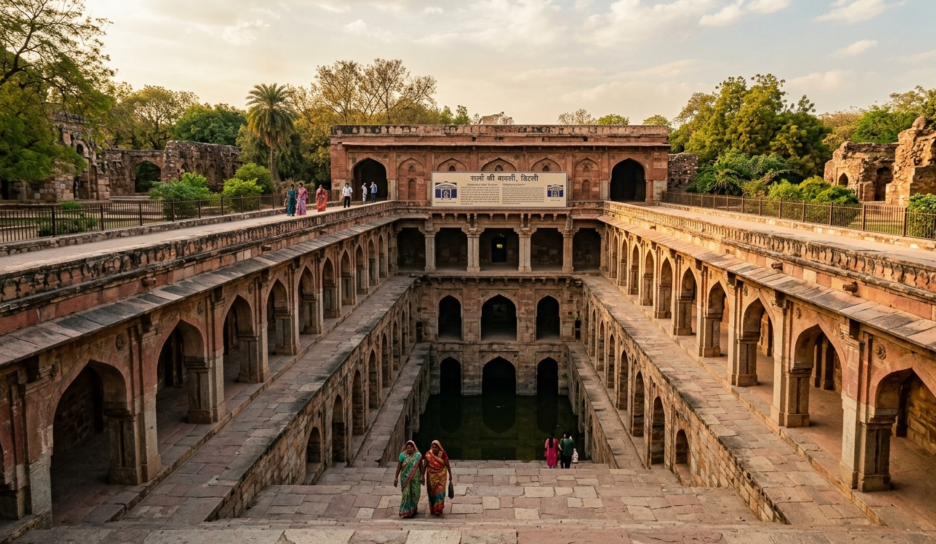
Gandhak Ki Baoli, Delhi :- The Architectural Legacy of the Oldest Surviving Stepwell
Detailed History
Gandhak Ki Baoli, secluded within the historic and ancient landscape of Mehrauli in South Delhi, adjacent to the Qutub Minar complex, stands as one of the oldest, most foundational, and historically significant stepwells (Baolis) in the nation’s capital. Far more than a relic of medieval water conservation, it serves as a structural chronicle of the early Delhi Sultanate.
The architectural creation of this monumental stepwell dates back to the early 13th century (around 1210–1235 AD), commissioned during the illustrious reign of Sultan Iltutmish, the premier ruler of the Slave Dynasty (Mamluk Sultanate). The nomenclature ‘Gandhak Ki Baoli‘ carries a fascinating scientific and chemical significance; ‘Gandhak‘ translates directly to Sulphur in Hindi. The subterranean natural springs that feed this stepwell are highly enriched with natural sulfur minerals. Historically, this infused water emitted a distinct mineral aroma. In medieval times, the water was widely revered for its therapeutic and medicinal properties, and people from distant regions traveled here to bathe and cure chronic skin ailments.
Detailed Architecture :-
The structural design of Gandhak Ki Baoli reflects the raw, robust, and functional aesthetic of the early Sultanate period, displaying a stark architectural contrast to the highly ornamental and arched stepwells built centuries later during the Lodhi and Mughal eras.
- Five-Tiered Subterranean Matrix :– The stepwell is carved deep into the local quartz ridge as a soaring five-story vertical column. A monumental, broad, and unadorned staircase descends from the southern landing, leading visitors directly down to the primary water basin.
- Post-and-Beam Structural Engineering :– Instead of employing expansive decorative arches, the architecture relies on a traditional post-and-beam system (trabeate style). Heavy, rugged stone pillars and solid horizontal stone beams support each descending tier. Continuous stone corridors line the lateral sides of each level, acting as viewing galleries and structural retaining frames.
- The Massive Circular Well Shaft :– At the deepest northern terminus of the descending steps lies the primary rectangular plunge pool, which is directly connected through a submerged conduit to a colossal circular well shaft. This deep vertical shaft tapped directly into the perennial underground aquifers of the ridge, ensuring a constant water supply.
- Photography Spots :– For architectural historians, documentary filmmakers, and minimalist photographers, Gandhak Ki Baoli offers a dramatic canvas. Capturing the sheer vertical plunge of the five-tiered structure from the topmost southern platform creates an exceptional visual frame highlighting architectural depth and geometric symmetry. The interaction of harsh daylight striking the rough, weathered yellow-red sandstone pillars against the dark, cool recesses of the lower tiers creates powerful shadows (chiaroscuro effects) optimized for fine-art heritage photography.
Travel Guide & Routes :-
- Ticket :– As a protected national monument under the direct care of the Archaeological Survey of India (ASI), there is absolutely no entry fee or ticket fee required for domestic or international tourists. Amateur still photography is entirely free.
- Visiting Time :– The monument premises are accessible daily from 06:00 AM to 06:00 PM. The most optimal window for exploration and clear photography is between 08:00 AM and 11:00 AM, when natural ambient sunlight perfectly penetrates the deep lower stone tiers.
- How to Reach :–
- By Metro :– The most practical transit routing is via the Delhi Metro Yellow Line. The closest transit hub is the Qutub Minar Metro Station. The stepwell sits approximately 1.5 kilometers from the metro exit, which can be easily covered via local auto-rickshaws or e-rickshaws navigating through the main Mehrauli village road.
- By Bus :– The historic Mehrauli Bus Terminal is the nearest local bus stop, located just a short walking distance from the stepwell entrance.
- By Road :– Commuters can travel via Anuvrat Marg or the Mehrauli-Gurugram Road (MG Road) to enter the peripheral village lanes. (Crucial Note: The interior lanes of Mehrauli village are highly narrow, historic, and heavily congested; driving a private four-wheeler directly to the monument gate is extremely impractical. Commuting via auto-rickshaws, two-wheelers, or walking from the main bus terminal is highly advised).
- Nearby Attractions :– Rajon Ki Baoli (located within walking distance), the Qutub Minar World Heritage Complex, Jamali Kamali Mosque and Tomb, Jahaz Mahal, and the Tomb of Ghiyasuddin Balban.
- Local Flavors & Famous Markets :– The vibrant pathways of old Mehrauli are heavily celebrated for authentic street food delicacies, including traditional crispy khasta kachoris, spicy samosas, and freshly fried syrupy jalebis. For an upscale dining experience, the immediate boundary of Qutub Minar hosts elite designer cafes and premium fine-dining rooftop lounges. Shopping enthusiasts can explore the centuries-old Mehrauli Bazaar, an iconic market deeply preferred for traditional ethnic wear, bridal trousseaus, handwoven textiles, and regional crafts.
Interesting Facts :-
- Gandhak Ki Baoli holds the proud historical distinction of being the oldest surviving stepwell in New Delhi, successfully maintaining its core structural integrity for over 800 years.
- According to ancient local folklore, the legendary 13th-century Sufi saint, Hazrat Khwaja Qutbuddin Bakhtiyar Kaki (whose revered shrine sits nearby in Mehrauli), regularly utilized the sulfur-enriched waters of this baoli for ablution, imparting a deep layer of spiritual sanctity to the site.
- Even during the apex of harsh summer heatwaves when modern water tables recede across the city, the deepest subterranean level of Gandhak Ki Baoli consistently retains freshwater, validating the masterful hydrological surveying of its medieval builders.
Important Questions and Answer :-
Question 1:– Is the sulfur-enriched water of Gandhak Ki Baoli still safe for bathing or medicinal usage today?
Answer:- While sulfur-enriched natural springs are scientifically proven to possess skin-healing properties, contemporary urban groundwater seepage and conservation protocols prohibit visitors from entering, bathing, or consuming the water in the primary pool.
Question 2:- Who built Gandhak Ki Baoli and when?
Answer:- The stepwell was commissioned and constructed under the direct royal patronage of Sultan Iltutmish of the Mamluk (Slave) Dynasty during his reign in the early 13th century.
Question 3:– How does the architecture of Gandhak Ki Baoli differ from the nearby Rajon Ki Baoli?
Answer:- Gandhak Ki Baoli is significantly older (13th century) and relies on a simpler, rugged post-and-beam structure with straight pillars. Conversely, Rajon Ki Baoli was built later in the Lodi era (16th century) and features highly ornamental pointed arches, multi-room cloisters, and an integrated mosque complex.
Author’s Thoughts :-
Emerging from the dense, chaotic modern lanes of Mehrauli and standing before the steep vertical drop of Gandhak Ki Baoli feels like uncovering a deep, forgotten chapter of Delhi’s foundation. This 800-year-old stone monolith stands as a quiet reminder of an era that seamlessly blended ecological survival with architectural utility. Sitting on the cool, weathered stone steps away from the urban noise, one can easily appreciate the advanced hydrological wisdom of our ancestors. It is an absolute must-visit sanctuary for any heritage enthusiast wishing to witness the raw, unedited, and timeless structural roots of the capital.
“Standing as a silent sentinel of the Slave Dynasty for over eight centuries, Gandhak Ki Baoli remains the grand patriarch of Delhi’s stepwells, anchoring the capital’s ancient hydro-engineering and therapeutic history.”